%2020_19_05.png)


El Niño and Ecuadorian floriculture: The silent threat to Valentine's Day 2027

Ecuador exports more than 500 million dollars a year in flowers and is the world's leading rose exporter. But the most important season on the floriculture calendar doesn't play out in February — it plays out four months earlier.
35% of annual exports depend on Valentine's Day, and the harvest for that date is defined between October, November, and December. It's precisely in those three months that international climate forecasts anticipate the worst-case scenario in nearly eight decades of records.
A historic El Niño, not just another one
According to NOAA's latest bulletin, El Niño is strengthening, with a greater than 90% chance of becoming a very strong event during the Northern Hemisphere fall and winter of 2026-2027. Sea surface temperature anomalies in the eastern equatorial Pacific already exceed +3.0°C, with values of +1.8°C in Niño 3.4, +2.5°C in Niño 3, and +3.4°C in Niño 1+2 — the region closest to the Ecuadorian coast.
Official models estimate a 75% probability that, between October and December 2026, an event will be recorded that surpasses in magnitude every previous event since 1950. The phenomenon is already here: this is not a routine preventive alert, but the critical window for Ecuadorian floriculture coinciding with its projected peak.
Why October–December is untouchable
Every rose shipped in February went through, months earlier, three stages that leave no room for error. This is where the season's first layer of complexity appears: the pinching calendar is not the same across the Sierra. In the south, pinching begins in October; in the north, it starts in November. That one-month difference means the same climate event can hit each zone at a different point in the cycle, so there isn't a single "risk window" for the country — there are at least two.
October/November – Pinching.The agronomist decides which stems stay alive: this is the "pinch." If the plant is stressed by cold, it doesn't sprout.
The following month – Bud development. Tud development. The bud must grow from 2 to 6 cm. It needs stable sun and cool nights, without frost. El Niño brings nights below 6°C and days of extreme radiation: the bud becomes deformed.
December – The wait. The wait. The flower must stay closed and firm until January. With relative humidity above 85%, Botrytis stains it and makes it unsellable.
Any failure at any of these stages can't be fixed later: it means losing the February box.
The uncertainty complicating planning
This season's real first challenge isn't the phenomenon itself, but the lack of reliable information on exactly how it will play out in the Sierra. Production cycles won't hold as they would in a normal year, but there's no clear answer yet on which direction planning should lean: extreme cold, frost, and drought — or intense heat and high daytime radiation? Both scenarios are possible, and each calls for a different agronomic approach.
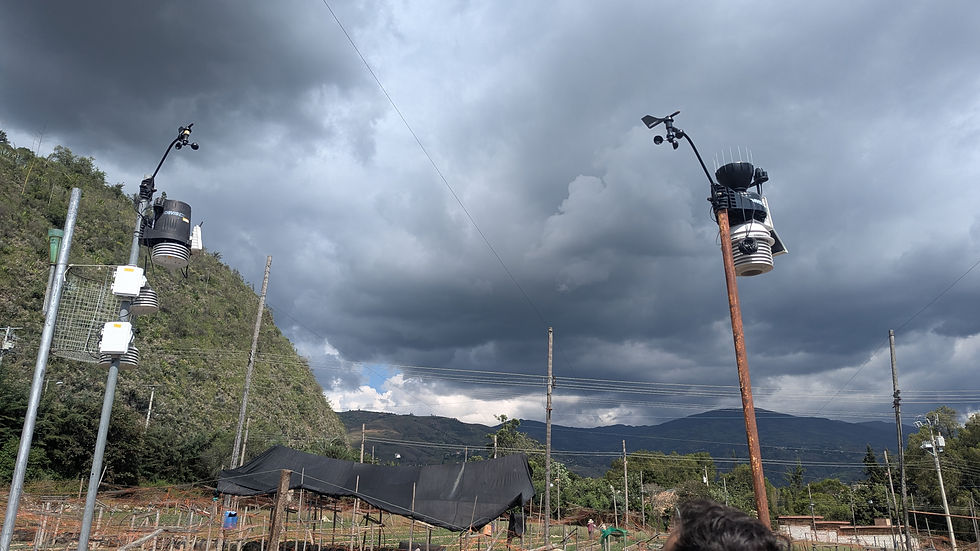
Faced with that uncertainty, the only real option is having the right technology in place: measuring constantly and analyzing climate data day by day, with tools within reach, available 24/7, delivering accurate data on the weather factors affecting the crop. That's what allows growers to adjust agronomic management in real time instead of reacting once the damage is already done.
This uncertainty is not a reason to wait — it's the reason to reinforce, now, the measures that protect the farm against either scenario: drainage, greenhouse covering, and plant nutrition.
The four blows El Niño deals a farm
1. Deformed buds and short stems. Thermal stress lengthens the cycle: a rose that should be ready in 85 days can take 100, missing the Valentine's Day flight.
2. A surge in Botrytis and mildew. A single stained petal is enough for an entire box to be rejected in Miami.
3. Root rot. Water standing for more than 72 hours suffocates the roots and cuts production by up to 20%.
4. Blocked export routes. 80% of Ecuadorian flowers leave through the Quito airport. A landslide on the Ruta Viva or the road to Tababela leaves the flowers stranded on the farm.
The cost of inaction
In the El Niño events of 1997 and 2023, Ecuadorian farms lost between 15% and 25% of their production. For Valentine's Day 2027, with an event that the models themselves describe as historic, that could translate into:
Breach of contracts already signed with U.S. supermarkets and distributors.
A per-stem cost up to 30% higher due to fungicides and heating.
Loss of the country's standing as a reliable supplier against competitors like Colombia and Kenya.
The likely outcome is that every producer will be affected to some degree, and that there will be less flower available for Valentine's Day 2027. That expectation is already shaping market behavior: international buyers, as in recent seasons, are placing their orders earlier instead of waiting until January.
The decision is made now
Valentine's Day isn't lost on February 14th. It's lost in October in the south and in November in the north. The farm that has already cleared its drainage, reinforced its greenhouse covering, and strengthened its plants with calcium and potassium to withstand both extreme cold and intense heat will save its harvest.


Comments