


INTEGRAL CONTROL STRATEGY FOR Botrytis cinerea IN EXPORT ROSESBOTREFIN®: Dual Mode of Action with ITALIAN TECHNOLOGY
1.- INTRODUCTION
Ecuadorian floriculture represents one of the country's most demanding agro-export pillars in terms of commercial quality and vase life. Within the phytosanitary framework, gray mold caused by Botrytis cinerea constitutes the biological challenge with the greatest economic impact. This necrotrophic fungus attacks petals and buds during the pre-harvest stage, and its latent mycelia severely infect flowers during maritime and air transit to international markets.
The climatic conditions of the Ecuadorian highlands (Sierra) — characterized by high relative humidity, condensation, and periods of low temperature — favor rapid sporulation of the pathogen. In addition, given a scenario of molecule restrictions under international socio-environmental regulations, the use of highly effective curative-preventive phytosanitary tools has become essential.
To meet this challenge, Agrocelhone del Ecuador Cía. Ltda. exclusively distributes BOTREFIN®, a fungicide of Italian origin developed by the company Finchimica S.p.A. Its water-dispersible granule (WG) formulation combines two complementary active ingredients with high functional synergy:
Cyprodinil (37.5%): An anilinopyrimidine that inhibits methionine biosynthesis and the secretion of the fungus's hydrolytic enzymes. It exhibits translaminar systemic penetration and rapid curative action.
Fludioxonil (25%): A phenylpyrrole with contact action and prolonged residual effect that disrupts signal transduction in mycelial osmoregulation, blocking conidial germination.
2.- PRODUCT TECHNICAL DATA SHEET
Parameter | Technical Specification |
Trade name | BOTREFIN® |
Composition | Cyprodinil 37.5% + Fludioxonil 25% |
Formulation | Water-dispersible granule (WG) |
National registration | 107-F12 / NA |
Origin | Finchimica, Italy |
Recommended dose | 0.5 g/L |
Packaging | 60 g / 100 g / 500 g |
3.- FIELD VALIDATION
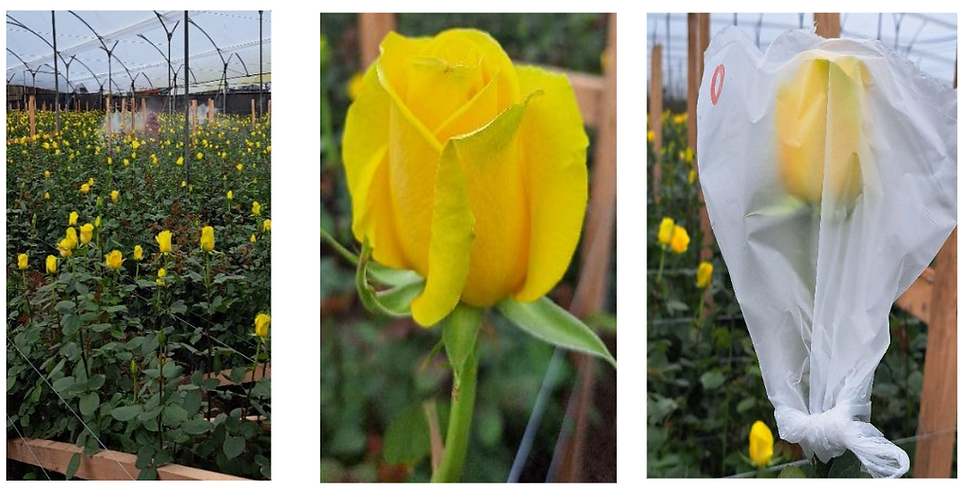
The field trial was carried out in a commercial greenhouse block in the rose-growing area of Tabacundo (Pichincha), evaluating the phytosanitary efficacy of BOTREFIN® on rose crops across 30 beds of the Summer Romance variety. A single foliar application was directed at the flower buds.
TREATMENTS | DOSE |
Untreated Control | -- |
Commercial Standard | 1.0 cc/L |
Botrefin® (Cyprodinil + Fludioxonil) | 0.5 g/L |
Wet-Chamber Methodology: After the drying period following application, 50 uniform flower buds were selected and tagged in the plot. Each tagged bud was individually covered with a plastic bag to create a microclimatic humid chamber on the plant itself. This procedure saturates relative humidity (>90%), forcing optimal environmental conditions for the germination and development of the fungus Botrytis cinerea.
4.- RESULTS EVALUATION AND STATISTICAL ANALYSIS
The behavior of flower buds subjected to the humid chamber was evaluated by measuring incidence (percentage of infected flowers), severity (percentage of petal area with necrosis), and the presence or absence of active sporulation.
Additionally, periodic inspection of buds and foliage was carried out to rule out any sign of spotting or phytotoxicity, confirming absolute safety with no adverse effects whatsoever.
Treatments (50 humid chambers each) | Commercial Dose | Final Incidence | Final Severity | Control Percentage |
Untreated Control | — | 80% | 16% | 0% |
Commercial Standard | 1.0 cc/L | 28% | 4.8% | 65% |
Botrefin® (Cyprodinil + Fludioxonil) | 0.5 g/L | 5.6% | 1.1% | 93% |
Figure 1: Statistical Representation of Botrytis cinerea Control (Incidence, Severity, and Efficacy) in Rose var. Summer Romance
Panel A (Incidence and Severity in Humid Chamber): Measures disease pressure on floral tissue. While in the untreated population (Control) 80.0% of flowers became infected, reaching 16.0% of necrotic area, the application of Botrefin® (0.5 g/L) reduced incidence to 5.6% (versus 28.0% for the commercial standard) and severity to 1.1% (versus 4.8% for the commercial standard), containing mycelial advance in the petals.
Panel B (Percentage of Botrytis cinerea Control): Represents the net phytosanitary efficacy of each treatment. Botrefin® achieved 93% total control, statistically significantly surpassing the protection provided by the commercial standard (65%). This response evidences the synergy of Cyprodinil + Fludioxonil in blocking conidial germination and cellular invasion of the fungus in export roses.
5.- CONCLUSIONS AND RECOMMENDATIONS
High Control Efficacy: BOTREFIN® demonstrated efficacy above 93.0% in controlling Botrytis cinerea, reducing incidence to 5.6% and severity to only 1.1%, notably outperforming the reference commercial standard (65.0% control).
Suppression of Latent Spores and Extended Vase Life: The complementary action of Cyprodinil + Fludioxonil prevents the development of latent mycelia and spores in flower buds, protecting the flower during post-harvest and extending its vase life.
Absolute Phytocompatibility: No symptoms of phytotoxicity or spotting were recorded on the yellow petals of the Summer Romance variety.
Usage and Phytosanitary Rotation Recommendation: It is recommended to integrate BOTREFIN® into a dynamic fungicide rotation program, applying a dose of 0.5 g/L during periods of higher climatic pressure (high humidity) or prior to export harvest peaks.


Comments